Short answer. The Vatican Museums are a long walk through galleries that lead to the Sistine Chapel, and St. Peter’s Basilica is a separate visit a little further on in Vatican City. If you only have a few hours, aim for the Raphael Rooms and the Sistine Chapel in the museums and the Pietà and the dome in the Basilica.
Tickets, guided tours and combined visits
Vatican Museums and Sistine Chapel: Entry Ticket
4.4· 49,797 reviews
from €38
Book tickets and tours →What is there to see in the Vatican Museums?
The museums are made of many collections joined by long corridors. You follow a one-way route, so there is no need to plan every room. These are the stops worth knowing about.
The Pigna Courtyard. It is named after a giant bronze pine cone. The courtyard reopened on 6 October 2026 after a restoration that began in 2016: its facades are back to the colour of travertine, and the marble and alabaster staircase that Gio Ponti designed in 1936 is visible again. The courtyard goes back to a plan by Bramante for Pope Julius II, who wanted to join the old papal palace to the Belvedere.
The Laocoon. This group shows a priest and his two sons twisting in the coils of serpents. The statue was found in Rome on 14 January 1506, and Julius II bought it and showed it in the Vatican about a month later. Many people count that moment as the birth of the Vatican Museums.
The Raphael Rooms. These rooms were frescoed for Julius II and Leo X. In the School of Athens, painted between 1509 and 1511, philosophers talk and argue under a great vaulted hall.
The Gallery of Maps. This is a long corridor with painted maps of Italy on the walls, made for Pope Gregory XIII between 1572 and 1585.
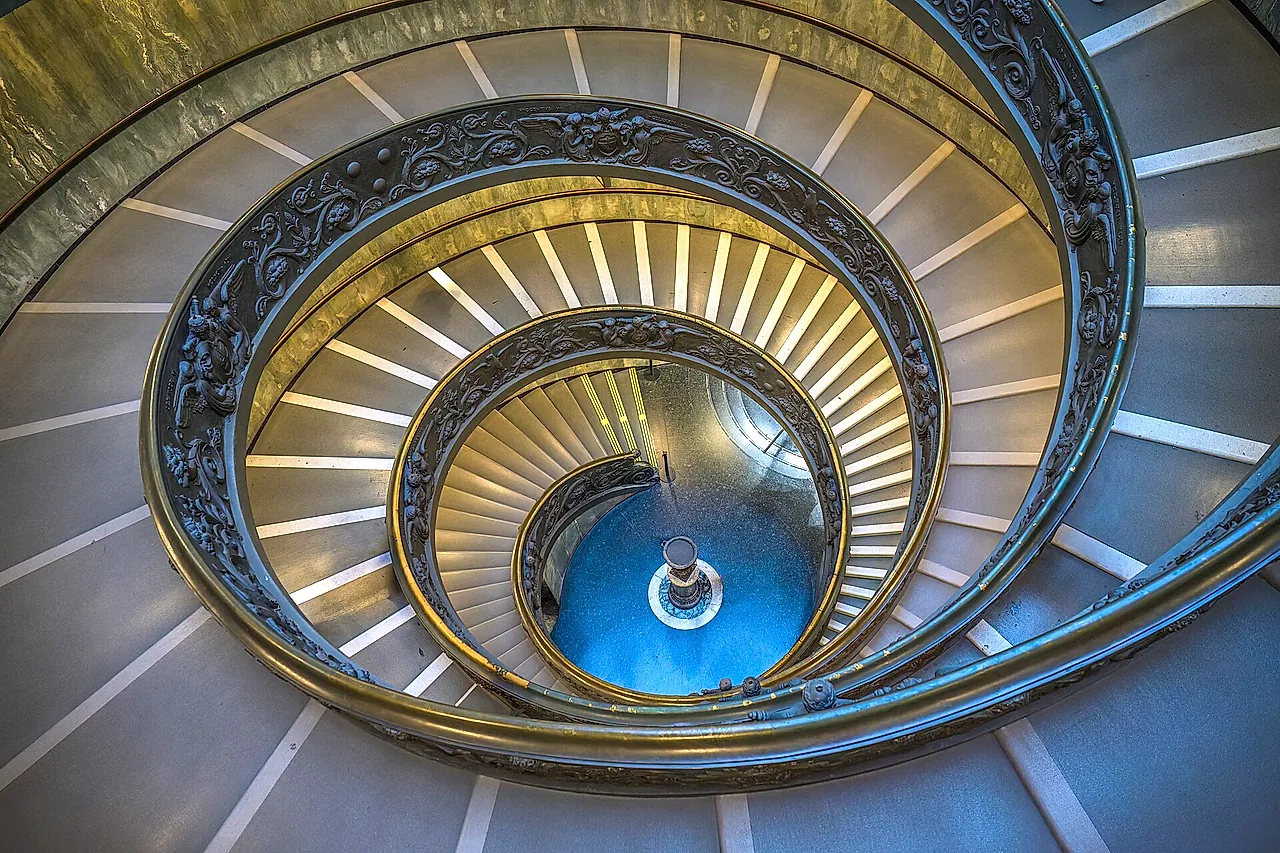
The double spiral staircase. Giuseppe Momo designed it in 1932. Two spiral ramps wind around each other in the same shaft, and it is one of the places where you can stop for a photo.
What is there to see in the Sistine Chapel?
The chapel was built between 1473 and 1481 for Pope Sixtus IV. The walls carry scenes from the lives of Moses and Christ, painted in the early 1480s by Perugino, Botticelli, Ghirlandaio, Cosimo Rosselli and others.
Michelangelo painted the ceiling for Julius II between May 1508 and October 1512. On the altar wall he painted the Last Judgment, which was unveiled in 1541. In early 2026 the surface of the Last Judgment was cleaned to remove a whitish film of calcium lactate, and the chapel stayed open during the work.
There are no photos in the chapel, and you must stay silent. Look up, let your eyes settle and take your time.
What is there to see in St. Peter’s Basilica?
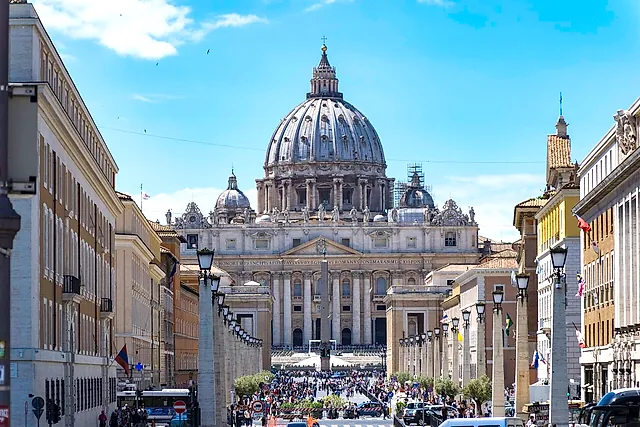
The square and the colonnade. Bernini’s curved colonnade, built in the 1600s, opens like two arms around the square. The Egyptian obelisk at the centre was raised in 1586 by Domenico Fontana under Pope Sixtus V.
The Pietà. In the first chapel on the right as you enter, Michelangelo’s Pietà dates from 1499. He made it for the French cardinal Jean de Villiers.
The baldachin. Under the dome stands the papal altar. Over it rises Bernini’s bronze baldachin, built in 1633 under Urban VIII, about 29 metres high.
The dome. Michelangelo directed the work from 1547. When he died in 1564 the drum was finished, and Giacomo della Porta completed the dome between 1588 and 1590. It measures about 123 metres from the floor to the lantern, and about 42 metres across.
The Grottoes and the tomb of St. Peter. Excavations under the Basilica began in 1939 under Pius XII. The discovery of what is believed to be the tomb of St. Peter was announced on 23 December 1950.
What is special in 2026?
The Basilica was consecrated on 18 November 1626, so 2026 is its 400th anniversary. The Jubilee of 2025 ended on 6 January 2026, and the Holy Door is now closed.
To plan the day, read how to buy tickets, the hours and how to get there and the history of the museums and the Basilica.